
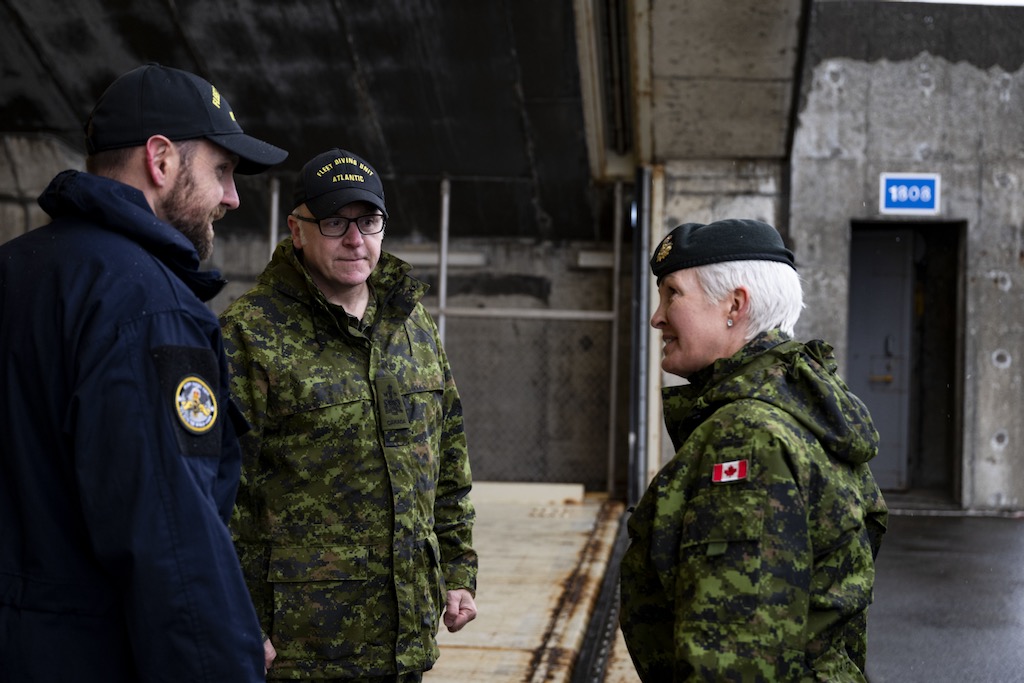
NATO selected a German general over Canada’s defence chief for the alliance’s top military role on Sept. 19.
Canada’s Chief of the Defence Staff, Gen. Jennie Carignan, and Germany’s defence chief, Gen. Carsten Breuer were both being considered for the position of chair of NATO’s military committee or CMC. Defence chiefs of the alliance’s nations held a secret vote Sept. 19 and selected Breuer.
I covered the news in a story for the Ottawa Citizen. I also did a couple of articles in the run-up to the NATO election:
Battle of the generals: Carignan versus Breuer
Will Canada’s top general win vote for key NATO job?
The Canadian government and Department of National Defence/Canadian Forces figured out in advance that Carignan wasn’t going to win, so the day before the election they went to the Globe and Mail with the news to pre-empt the loss.
The Globe is the “go to” newspaper for the military leadership to plant positive articles, send out trial balloons and preempt bad news. So the Sept. 18 article noted that Canada was not counting on a Carignan win. In typical Globe and Mail fashion, that article was entirely based on unnamed “sources.”
The Globe put the blame on a “lack of U.S. support,” which its sources claimed was an “insurmountable obstacle.”
The CBC also reported on the lack of U.S. support. The CBC quoted Carleton University professor and DND stakeholder Stephen Saideman saying that Trump would block Carignan.
Maybe. The U.S. only had one of the 32 votes, but could have swayed other nations.
Or maybe there was more to the loss than the Globe and CBC stories portrayed.
As I reported, both Carignan and Breuer have impressive military records with multiple deployments. But Carignan’s claim to fame is being a significant force behind the reforms aimed at culture change in the Canadian Forces. She was named chief of the defence staff in the summer of 2024, becoming the first woman to take on that role.
NATO, on the other hand, is looking to transform the alliance for future military operations, with an emphasis on new technology and war-fighting skills.
And that is where Breuer fits in. As I wrote in the Ottawa Citizen article, Breuer has NATO headquarters experience, having served as the Deputy Supreme Allied Commander Transformation Representative in Europe. But Breuer is also seen as being instrumental in pushing Germany’s historic modernization and rearmament program, as well as being a leading voice for raising support for NATO’s strategy following Russia’s invasion of Ukraine. Just as important, Breuer hustled to win the job.
The news outlet Politico reported Saturday that Breuer made multiple trips to NATO capitals to meet with fellow military leaders and actively make a case that he should be elected as CMC. Recent stops included Albania, North Macedonia, the U.S., Slovenia, Latvia and Estonia – all in the past two months, according to Politico.
Carignan “reached out to her counterparts” according to Defence Minister David McGuinty. McGuinty said he also supported Carignan’s campaign by writing letters to “different ministers to suggest that she would be a fine candidate.”
That doesn’t exactly sound like an aggressive campaign to win the job.
Retired Canadian Forces Col. Brett Boudreau, who served on the staff of Canadian Gen. Ray Henault’s staff when he was Chief of the Military Committee, posted on X that the appeal to NATO military chiefs to elect a woman to the position because that would be a first-time event was a profound and strategic miscalculation.
“NATO wants more Canada, but needs more Germany,” Boudreau wrote. “The German (general) has been a visionary officer as military head, publicly leading and actively communicating the charge for the swift modernization and recapitalization of their armed services. The media-shy Canadian CDS was the accidental beneficiary of a change of government that turned a firehose of $$$ at Defence, forcing change on an institution increasingly more closed and opaque than open and transparent.”
Bourdeau characterized Carignan as “media shy” – pointing out that NATO needed a spokesperson for its new chairman of the military committee who could clearly explain to the public and journalists about the changing alliance policies. In other words, the media-shy Canadian general wasn’t a good fit for that role.
But should a more accurate description of Carigan be “media averse”?
I thought back to a September news conference at a major security meeting in Victoria, British Columbia, with Carignan and U.S. Navy Admiral Samuel Paparo, head of U.S. Pacific Command. Paparo was on the hot-seat when Global News reporter Ben O’Hara-Byrne asked him whether he would obey an order from Trump to invade Canada. You can read about that in my Ottawa Citizen piece:
U.S. admiral dodges questions about attacking Canada but acknowledges he would follow Trump’s orders
In the question-and-answer session Carignan looked on as Paparo handled the tough questions.
But after the news conference ended, Paparo walked up to each of the journalists, shook their hand, and chatted a bit. He specifically sought out O’Hara-Byrne as well to talk to the reporter and assure him he was not trying to be disrespectful in any way in how he answered the journalist. U.S. military officers are often like this, comfortable with the news media even when facing the tough questions.
And Carignan? She scooted from the room without saying a word to anyone. Apparently she also had a senior public affairs official in the room, Doug Keirstead, or so I was told by DND officials. But no reporters even knew he was there.