
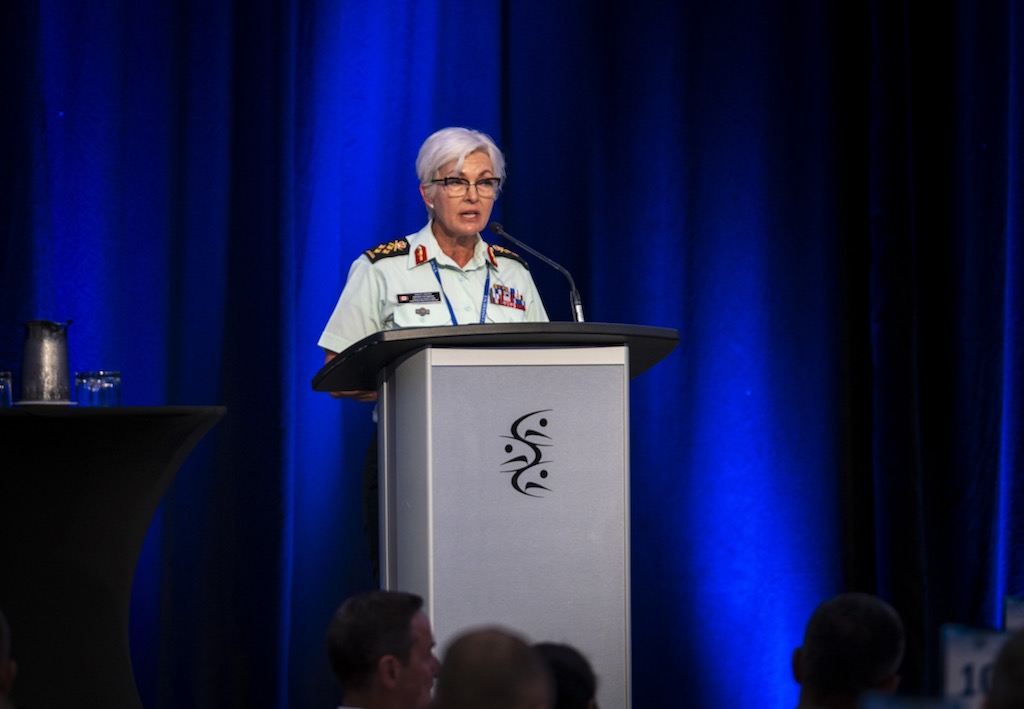
Earlier this year retired Gen. Tom Lawson, a former chief of the defence staff, had nothing but praise for Gen. Jennie Carignan’s new mobilization plan.
Speaking at a March gathering of the Conference of Defence Associations, Lawson suggested to the audience that defence chief Carignan proactively released her plan calling for the creation of a massive new reserve force. Lawson also complained about how an unnamed media outlet attacked Carignan over her initiative outlined in a May 2025 document, which called for the creation of a 300,000-strong supplementary reserve force and a boost to the primary reserves to 100,000 from the current 23,561.
I wasn’t surprised. Lawson and the defence-industry-DND-funded Conference of Defence Associations have heavily criticized journalists in the past, or at least those who write less-than-flattering articles about the Canadian Armed Forces.
My family has been on the receiving end of some of that. I still remember the time in July 2015 when Lawson, as chief of the defence staff, interrupted our family’s supper with a phone call to inform me that I “sickened him.”
Lawson was not happy that I wrote an article about the ill treatment by the Canadian Forces of Shaun and Sheila Fynes of Victoria, B.C. (Their son, an Afghan veteran, had committed suicide). Lawson tried, unsuccessfully, to get my article killed. When that didn’t happen, the Canadian Forces issued a news release denouncing my reporting. But ultimately that backfired and a few days later Lawson had to issue an apology to Sheila Fynes.
At the time, I covered this whole fiasco with a number of articles:
Soldier’s parents disgusted by general’s letter
Medals wrongly issued after Afghan vet’s suicide, Lawson tells parents
Top general apologizes to family
On the issue of Carignan’s mobilization plan, Lawson was also wrong. The plan was never proactively released by Carignan. Instead, defence sources leaked the mobilization scheme to me, pointing out that Carignan was keeping it under wraps and that the concept was poorly planned and impractical.
But Lawson was right about one thing. Once Carignan’s mobilization plan was put out in public by the Ottawa Citizen, it was openly mocked by veterans and media commentators. One particular aspect of Carignan’s plan that came under intense criticism was its reliance on using public servants for the new reserve force.
The situation wasn’t helped by the damage control efforts by the Liberal government and Carignan herself.
After the article was published, officials in Defence Minister David McGuinty’s office started telling Ottawa-based journalists that what I reported wasn’t accurate.
Then Carignan joined in. During a Nov. 11, 2025, live broadcast on CTV for Remembrance Day, she told the network anchor that what I wrote was “not quite correct.”
“It is not focused directly to public servants,” she told CTV about her mobilization plan. “Our public servants are already contributing extensively to the work we are doing in defence.”
I have no idea whether Carignan was getting bad advice from her military public affairs officer or whether she herself thought that claiming the Ottawa Citizen published the wrong information was a good idea. But here is a free lesson in media relations for the Canadian Forces leadership: If you are going to accuse a reporter of publishing inaccurate information, you had better make sure you have your facts correct.
In Carignan’s case, she didn’t.
Since I had a leaked copy of Carignan’s actual mobilization document, I recommended that the Ottawa Citizen publish portions of it to show not only did we have her document but that she was wrong in claiming the initiative didn’t have anything to do with public servants.
I also asked Carignan for comment on why she claimed her mobilization plan didn’t rely on public servants when clearly it did. She didn’t provide any comment.
Later, Carignan had to backtrack after the Ottawa Citizen published actual portions of the document: Top soldier has second thoughts about recruiting public servants for reserves.
Those portions clearly stated that the plan “should initially prioritize volunteer public servants.” Carignan never apologized for her false claims.
But former senior military public affairs officers questioned how the Canadian Forces was caught off guard by not having a proper communications plan for such a major initiative.
Retired colonel Brett Boudreau said a robust mobilization framework was a long-standing need for defence of the country, but that the leadership dropped the ball on explaining this to Canadians.
“It’s another classic study of a failure by defence leaders to anticipate public interest in their activities and planning, even if just at the gestation stage, and to build in communications as an integral part of their work,” said Boudreau, who was a former senior public affairs officer.
And Carignan’s response, to falsely claim the Ottawa Citizen article was not correct, did not surprise Boudreau. “The gut instinct, still, of most senior CAF leaders is to blame everyone but themselves, usually to scapegoat the media, for military-related coverage they do not like, for whatever reason, even if embarrassment is well and truly deserved,” he explained. “It’s a curious feature of, and sad commentary about, a seriously dated institutional mindset toward the public communications function.”
Retired navy captain Dave Scanlon, a former senior military public affairs officer, also questioned why Canadians weren’t brought in on the plans for a significant mobilization scheme that would affect the entire country.
“Larger reserve forces must be part of that conversation, but an internal defence directive is not where the conversation ideally should have started,” he wrote in an opinion piece in the Ottawa Citizen.
“Any mobilization plan must be anchored in explicit political direction, supported by elected officials, and debated openly. It is troubling the directive cites no political guidance or authority. For a national project as complex and potentially controversial as mobilization, that absence is conspicuous,” Scanlon added.
Now there are questions about whether Carignan’s mobilization scheme will ever come to fruition.
On Nov. 9, 2026, I reported in a story in the Ottawa Citizen that the Canadian Forces has yet to present the Liberal government with its mobilization plans despite Carignan’s claims by that this would be done by June 2026.
More worrisome to some is that the Canadian Forces and DND can’t say when the plan will be ready. This has prompted speculation that the mobilization initiative will never see the light of day…or at least be properly implemented.
It’s interesting that retired General Lawson and the CDA have been strangely quiet about these developments.